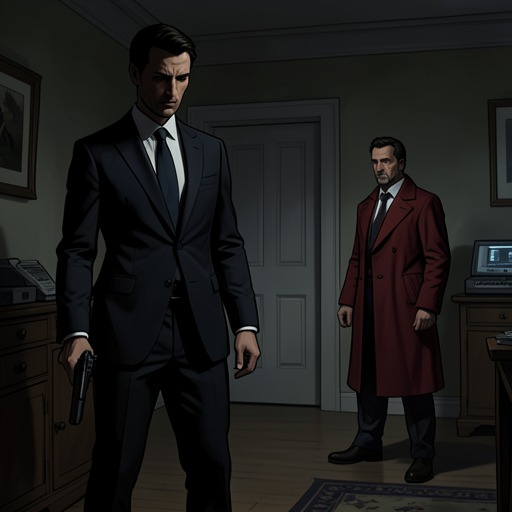
Bond’s moral crisis over good and evil
Casino RoyaleBond’s moral crisis over good and evil emerges after Le Chiffre has tortured him and Bond has been brought back from the brink of death. The experience unsettles the clean division between heroes and villains on which Bond’s professional identity has rested: he recognizes that the man who once killed supposed villains can also find himself cast as a villain by an enemy, and that duty, patriotism, and personal revenge do not amount to the same moral justification. His doubts prompt him to speak of resigning, but Mathis answers that exposure to actual cruelty may sharpen Bond’s judgment and renew his resolve to protect people he loves.
The Crisis and Its Immediate Cause
The reckoning takes shape during Bond’s recovery, in conversation with Mathis. Bond explains that, while being beaten, he suddenly became attached to the idea of remaining alive. He recalls Le Chiffre’s phrase “playing Red Indians,” which had made him consider whether the work he had treated as heroic might instead resemble a game of killing. His immediate response is to tell Mathis he has decided to resign. The decision connects physical vulnerability to professional doubt: a man who had accepted lethal force as part of his service now questions the moral story that had made that force seem straightforward.
Bond’s doubts are not merely a response to the prospect of death. His body remains painfully swollen and bruised, and he continues to suffer when his injections wear off. Although the doctor assures him that his health and powers will return, Bond’s own perception of his condition does not agree with those assurances. The torture has also left him afraid that his sexual capacity may have been destroyed. That fear makes his uncertainty about manhood concrete: Le Chiffre had threatened not only bodily pain but the loss of Bond’s sense of himself as a man. His reflections on heroism unfold in the same period as this shaken confidence, not from a position of effortless professional certainty.
Heroes, Villains, and the Double-O Past
Bond sets his present hesitation against the history that earned him his Double-O number. He recalls two killings. In New York, he shot a Japanese code specialist from a room across the street, after a colleague’s bullet broke the window. In Stockholm, he killed a Norwegian double agent whose betrayal had led to the capture of two British agents; Bond describes that second job as silent and says the man did not die quickly. The contrast between a long-distance shot and a close, difficult killing complicates any simple account of violence as a clean professional act.
Bond explains that his Double-O status means that he has killed a man in cold blood during a mission. The distinction once gave him a reputation for being tough and capable, and he remembers having felt clever about the work. Now he turns the same heroic convention inside out: if Bond can kill a villain, Le Chiffre can try to kill Bond while seeing him as the villain. The labels do not hold still when each side claims its own cause. Bond does not deny that Le Chiffre has done evil; he questions the assumption that the person acting under the name of duty therefore occupies an uncomplicated moral position.
His doubts extend from individual enemies to political history. Patriotism can make violence seem acceptable as service to one’s country, Bond concedes, but he distrusts the idea that political allegiance settles the question. He argues that the conservatism treated as respectable in his own time might have been branded communism fifty years earlier. As political alignments change, those called heroes and villains can exchange roles. The point is not that all causes are identical, but that the historical language used to certify a cause is unstable—and therefore cannot, by itself, guarantee moral innocence.
The Devil and the Missing Account of Evil
Bond pushes his reconsideration beyond his own career into an argument about how goodness is understood. He says he feels sorry for the Devil and likes to side with the underdog, then contrasts the established account of goodness with the absence of an equivalent “Evil Book.” In his formulation, the Devil has no prophets to set out commandments and no sustained account of evil’s different forms. People are left with inherited stories about wickedness and their own intuition. The deliberately provocative argument exposes the imbalance in the moral framework Bond has been taught: goodness has an authorized language, while evil is largely identified through examples and contrast.
From this thought, Bond draws an unsettling conclusion about Le Chiffre. Le Chiffre’s existence, he argues, supplied a measure of badness against which goodness could be recognized; by helping destroy him, Bond may have eliminated an example that served that purpose. The reasoning is not a declaration that Le Chiffre’s actions were harmless or that Bond’s victim is innocent. Rather, Bond dramatizes how far his moral uncertainty has travelled: even the enemy whose cruelty he has experienced becomes part of an abstract argument about the conditions under which people recognize virtue. Mathis treats this as an overcomplication of a practical duty, while Bond’s speech makes clear that the practical vocabulary of good and evil no longer feels self-explanatory to him.
Mathis’s Answer: Experience and Responsibility
Mathis challenges Bond’s doubts by returning them to specific consequences. He points out that Le Chiffre tried to destroy Bond’s manhood and argues that this does not disqualify Le Chiffre from being a villain. He also objects to the idea that Bond can afford indifference to SMERSH, whose members kill those they consider traitors. Mathis calls Bond an anarchist, framing his rejection of easy moral categories as a refusal to accept the responsibilities that accompany judgment. His response is not a competing philosophical treatise so much as a demand to recognize what political violence does to actual people.
Bond, for his part, admits that he would kill Le Chiffre if they met again, but says that revenge for the evil done to him—not a high moral principle or service to his country—would be his motive. This distinction is central to the crisis. Bond does not claim to have become incapable of action; he doubts the nobility of the explanations that can be attached to it. The admission leaves the conflict unresolved at the level of abstract justification, but it identifies the personal motive he can acknowledge without disguise.
Mathis offers a practical answer to Bond’s announced resignation. Once Bond returns to London, Mathis predicts, M will tell him about other enemies threatening Bond, his friends, and his country. Bond’s experience of Le Chiffre will help him recognize the harm such enemies can inflict, and Mathis expects him to act against them to protect himself and those he loves. He allows that Bond may become more selective, insisting that targets should truly be evil, but argues that discernment need not mean withdrawal. His final counsel is to surround himself with human beings, since they are easier to fight for than principles. The advice shifts the basis of action away from a perfect doctrine and toward particular relationships.
Aftermath and Narrative Significance
The crisis belongs to a longer recovery, in which Bond’s confidence in his body and his confidence in his moral identity are both unsettled. He hesitates to see Vesper because he fears that his desire may not return; over time, their daily companionship becomes a pleasure amid treatment, and he gradually recovers enough to sit in the garden, walk, and ride in a car. This movement toward restored health does not erase the doubts voiced to Mathis. Instead, it places them within a period when Bond must relearn what his body can do and reconsider what his professional role demands.
The exchange marks a change in Bond’s understanding of killing rather than a settled rejection of his work. He has moved from the youthful certainty that heroes kill villains toward suspicion of categories shaped by circumstance, political change, and self-interest. Yet Mathis’s appeal to concrete people and recognizable harm gives that suspicion a possible limit: moral hesitation can make Bond more careful about whom he targets without making him indifferent to those in danger. The argument therefore holds two pressures together—the danger of treating patriotic labels as proof of goodness, and the danger of allowing skepticism to become an excuse for refusing responsibility. Bond’s crisis ends without a clean resolution, but with a more personal basis for action beginning to take shape.